
High cyanuric acid (CYA) is a persistent issue for many pool owners.
It builds up gradually, often entering the water through stabilized chlorine sources like trichlor tablets.
When CYA levels climb past 100 ppm, chlorine becomes less effective at sanitizing the water, leading to algae blooms and frustrated owners.
Traditionally, the standard advice was a partial or full drain and refill.
However, draining a pool is water-intensive, can damage pool surfaces such as vinyl liners or fiberglass shells, and may violate local water usage ordinances. Fortunately, modern pool chemistry and filtration offer reliable alternatives.
This article explores three proven methods for lowering CYA without draining your pool.
Why High CYA Is a Problem
CYA acts as a stabilizer, protecting chlorine from breaking down under ultraviolet sunlight. However, when levels climb past 80 to 100 ppm, it creates a condition often called chlorine lock.
At high concentrations, a significant portion of your chlorine becomes chemically bound and unable to sanitize effectively.
You may test 3 to 5 ppm of free chlorine, but the active sanitizing portion is too low to kill bacteria and algae.
This leads to cloudy water, increased chlorine demand, and expensive chemical maintenance.
Keeping CYA between 30 and 50 ppm ensures your chlorine works efficiently.
Method 1: Aluminum Sulfate Flocculation
One of the most effective chemical approaches is the alum treatment. This process uses aluminum sulfate to bind with CYA particles, forming a heavy floc that settles on the pool floor.
To begin, adjust your pH down to 7.0.
This specific pH level is critical for the reaction to occur. Ensure water temperature is between 70°F and 90°F.
With the pump off, set your multiport valve to the recirculate position.
If you have a cartridge filter, remove the filter element completely.
Add the aluminum sulfate at a rate of roughly 8 pounds per 10,000 gallons of water.
Run the pump for two hours to circulate the chemical, then shut the system down completely.
Allow the pool to sit undisturbed for at least 12 hours.
A milky cloud will form and eventually settle into a dense layer of sediment on the pool floor.
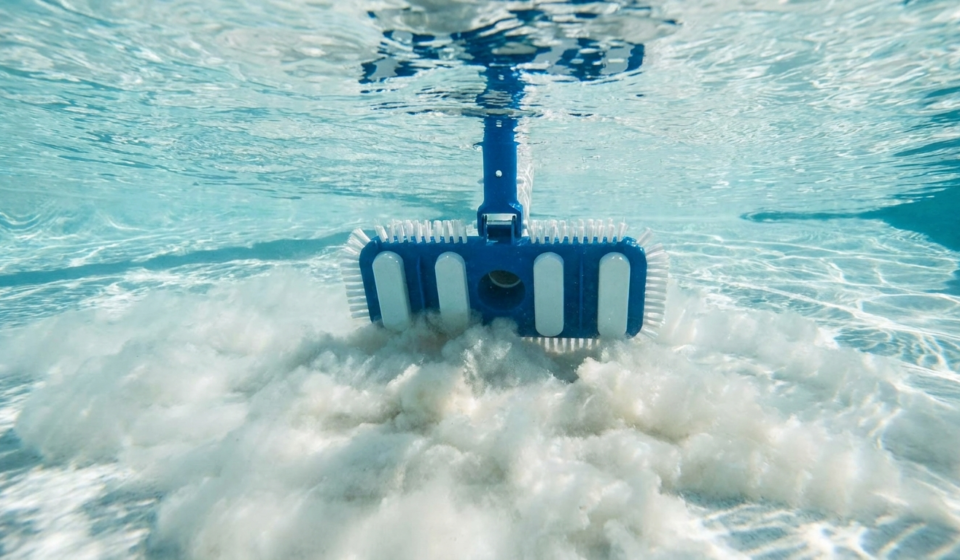
Using a manual vacuum, vacuum the floc directly to waste.
Move the vacuum head slowly to avoid breaking up the sediment.
After vacuuming, test the residual aluminum levels in the water. They should be below 0.2 ppm. Finally, retest your CYA levels.
Pool professionals report CYA reductions of 40 to 50 percent using this method.
Method 2: Reverse Osmosis Filtration
Reverse osmosis is a mobile water purification service for swimming pools. A specialized trailer pumps pool water through semi-permeable membranes that remove dissolved solids, including CYA, calcium, salts, and phosphates.
RO filtration can recycle up to 85 percent of the existing pool water, making it a highly water-conservative option.
In one documented case, a commercial pool with CYA levels at 160 ppm was treated with RO and brought down to 0 ppm in a single service.
This method also addresses high calcium hardness and total dissolved solids, which are common secondary issues in pools with aged water.
While RO services typically cost more than chemical treatments, they offer a complete water overhaul without the structural risks of draining. For pool owners with hard water or multiple chemical imbalances, RO provides a comprehensive solution that saves time and water.
Method 3: Biological and Enzyme Reducers
Biological CYA reducers offer a simpler, though sometimes slower, approach. These enzyme-based products are added directly to the pool water, where they naturally break down cyanuric acid over time.
These products generally require warm water, ideally above 65°F, and a low-chlorine environment to work effectively. You may need to turn off your chlorine generator or feeder during the treatment process. Results are typically observed within 7 to 10 days.
While safe for all pool types and easy to use, biological reducers have limitations.
Their effectiveness varies depending on water chemistry and the severity of the CYA issue.
They are often best suited for moderately high CYA levels, such as 60 to 100 ppm, rather than severe cases exceeding 150 ppm.
For very high levels, mechanical or chemical methods may deliver faster and more predictable results.
For pool owners who want to avoid the hassle of flocculation or the cost of advanced filtration, consistent maintenance and proactive chemistry management are key.
Understanding the science behind lowering CYA without draining gives you the flexibility to choose the best method for your specific situation, whether that is an alum treatment, an enzyme additive, or a mobile RO service.
Preventing High CYA in the Future
Once you have successfully lowered your CYA, changing your sanitizing routine will prevent the problem from recurring.
The primary culprit is stabilized chlorine in the form of trichlor tablets.
A single 3-inch tablet can add roughly 6 ppm of CYA to 10,000 gallons of water.
Using two to three tablets per week during swim season leads to significant buildup over just a few months.
Switching to unstabilized chlorine sources, such as liquid sodium hypochlorite or cal-hypo shock, will stop the CYA cycle entirely. These sanitizers contain no cyanuric acid.
Test your CYA levels at least once a month during swim season, and more often if you are using tabs regularly.
Catching the trend early prevents the need for intensive treatment later.
Choosing the Right Method for Your Pool
High CYA does not have to mean a costly drain and refill.
Whether you choose the rapid results of alum flocculation, the comprehensive purification of reverse osmosis, or the simplicity of biological reducers, you can restore your pool’s chemical balance without wasting water.
Evaluate your pool’s specific needs, your budget, and your current CYA level to select the most appropriate solution.
With the right approach, you can keep your pool clear, safe, and efficient all season long.