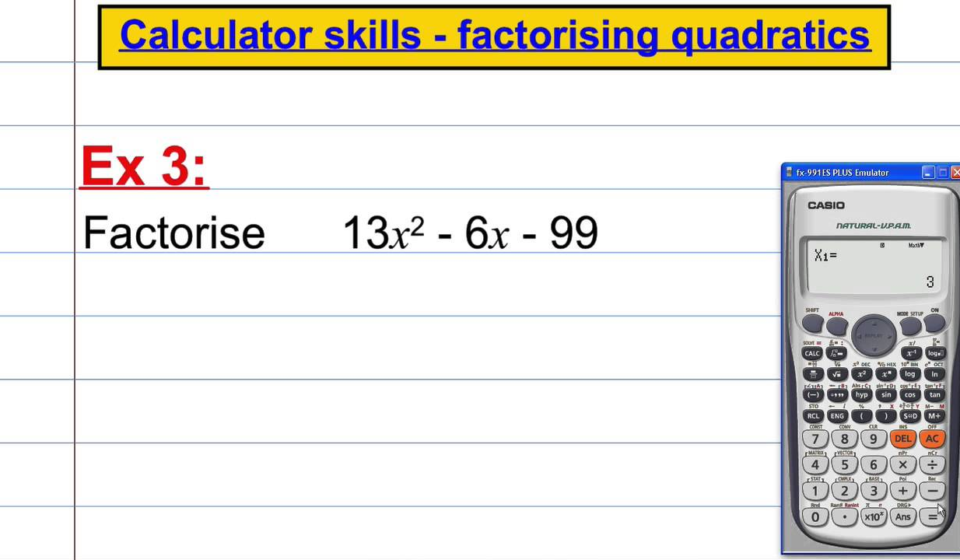

Have you ever looked at a big math problem and felt stuck? Math can sometimes feel like a puzzle with too many pieces. You might see a huge number or a long algebra problem and wonder where to start. That is where a smart tool comes in to help!
A factor calculator is a handy helper for students, parents, and teachers. It takes large numbers or complex expressions and breaks them down into smaller pieces. In this guide, we will explore how factors work, how online math tools save you time, and how you can master factoring with ease.
What Is a Factor Calculator and How Does It Work?
A factor calculator is an online math tool designed to break down whole numbers or algebraic equations into their building blocks. When you enter a value into the tool, it runs quick math algorithms to find every number that divides into your input without leaving any leftover remainder.
Think of a factor calculator as a digital magnifying glass for numbers. Instead of spending ten minutes testing numbers on paper, you get instant answers showing factor pairs, prime factors, and step-by-step solving methods.
Why Is Factoring So Important in Math?
Factoring is one of the foundational skills in basic arithmetic and high school algebra. Understanding factors helps you simplify fractions, solve quadratic equations, and find common denominators quickly. Without factoring, solving advanced math would feel like building a house without bricks.
When you master factors, you build strong problem-solving skills. You start noticing patterns in numbers faster, which makes learning mental math much easier.
Understanding Factors, Multiples, and Prime Numbers
To get the most out of a factor calculator, it helps to know three basic terms:
- Factors: Whole numbers you multiply together to get another number. For instance, 2 and 3 are factors of 6 because 2 times 3 equals 6.
- Multiples: The numbers you get when you multiply a starting number by whole numbers. The multiples of 5 are 5, 10, 15, 20, and so on.
- Prime Numbers: Numbers greater than 1 that have only two factors: 1 and themselves. Examples include 2, 3, 5, 7, and 11.
Step-by-Step Guide: How to Find Factors Manually
Before using a tool, it helps to know how to find factors on paper using trial division.
- Start with the number 1 and the target number itself as your first factor pair.
- Test the number 2. If the target number is even, divide it by 2 to get its matching pair.
- Continue testing whole numbers (3, 4, 5, etc.) up to the square root of your target number.
- Write down every pair that divides evenly with zero remainder.
Complete Quick Reference Table for Common Number Factors
Here is a quick look at how common whole numbers break down into their factor pairs and prime factors:
| Number | All Positive Factors | Prime Factorization | Total Number of Factors |
| 12 | 1, 2, 3, 4, 6, 12 | 2 x 2 x 3 | 6 |
| 18 | 1, 2, 3, 6, 9, 18 | 2 x 3 x 3 | 6 |
| 24 | 1, 2, 3, 4, 6, 8, 12, 24 | 2 x 2 x 2 x 3 | 8 |
| 36 | 1, 2, 3, 4, 6, 9, 12, 18, 36 | 2 x 2 x 3 x 3 | 9 |
| 48 | 1, 2, 3, 4, 6, 8, 12, 16, 24, 48 | 2 x 2 x 2 x 2 x 3 | 10 |
| 60 | 1, 2, 3, 4, 5, 6, 10, 12, 15, 20, 30, 60 | 2 x 2 x 3 x 5 | 12 |
| 100 | 1, 2, 4, 5, 10, 20, 25, 50, 100 | 2 x 2 x 5 x 5 | 9 |
How to Factor Algebraic Expressions and Polynomials
Factoring is not just for plain numbers; it is also a huge part of algebra. Polynomial factoring involves breaking down expressions like trinomials into smaller binomials.
For example, to factor $x^2 + 5x + 6$, you look for two numbers that multiply to 6 and add up to 5. The numbers 2 and 3 work because $2 \times 3 = 6$ and $2 + 3 = 5$. Therefore, the factored expression is $(x + 2)(x + 3)$. An advanced factor calculator can handle these steps automatically in seconds.
Common Polynomial Factoring Patterns
When working on algebra homework, recognizing repeating math patterns can speed up your work significantly:
- Greatest Common Factor (GCF): Pulling out the largest shared factor from every term.
- Difference of Squares: $a^2 – b^2 = (a + b)(a – b)$.
- Perfect Square Trinomials: $a^2 + 2ab + b^2 = (a + b)^2$.
- Sum or Difference of Cubes: Formula patterns used for third-power expressions.
Real-Life Examples Where Factoring Is Useful
You might wonder when factoring applies outside of a math classroom. Factoring is used constantly in everyday scenarios:
- Arranging Events: If you have 48 chairs and want equal rows, factoring tells you all seating layout options (e.g., 4 rows of 12 or 6 rows of 8).
- Sharing Supplies: When dividing snacks or crafts among friends, factors show how to make equal groups without leftover waste.
- Computer Coding & Security: Prime factors are the backbone of modern data encryption, keeping online communications safe and private.
Top Benefits of Using an Online Factor Calculator
Using a factor calculator offers clear benefits for learners of all ages:
- Saves Time: Instant results eliminate long, repetitive division calculations on paper.
- Eliminates Errors: Digital tools prevent simple arithmetic mistakes when checking homework.
- Shows Step-by-Step Work: Many tools explain each step so you can learn how the answer was found.
- Boosts Learning Confidence: Verifying your paper calculations gives you peace of mind before turning in assignments.
Tips for Getting the Most Out of Your Math Calculations
To get accurate results when using a factor calculator, keep these simple guidelines in mind:
- Double-check the numbers or symbols you type into the input field.
- Use proper algebraic formatting, such as
^for exponents (likex^2). - Always review the step-by-step breakdown rather than just copying the final answer.
- Practice solving problems on paper first, then use the tool to check your accuracy.
Frequently Asked Questions
What is the difference between a factor and a multiple?
A factor is a number that divides into a target number with zero remainder. A multiple is the product you get when you multiply a given number by whole numbers.
Can negative numbers have factors?
Yes, negative numbers have negative and positive factors. For example, the factor pairs of -6 include (1, -6), (-1, 6), (2, -3), and (-2, 3).
What is prime factorization?
Prime factorization is breaking down a composite number until it is written entirely as a product of prime numbers. For instance, the prime factorization of 12 is $2 \times 2 \times 3$.
Why does every number have at least two factors?
Every whole number greater than 1 can be divided evenly by 1 and by itself. Numbers with only those two factors are called prime numbers.
How does a factor calculator solve algebra equations?
An algebraic factor calculator uses algorithms like the GCF method, grouping, or quadratic patterns to break polynomials into simpler binomial products.
Can all polynomials be factored?
Not all polynomials factor neatly using whole integers. Those that cannot be broken down further using simple integers are called irreducible polynomials.
Conclusion
Mastering math concepts becomes much easier when you have the right strategies and tools at hand. Using a factor calculator allows you to verify your work quickly, understand step-by-step solutions, and build real confidence in math. Next time you face a tough factoring problem, try solving it on paper first, then check your steps with a factor calculator to solidify your understanding!